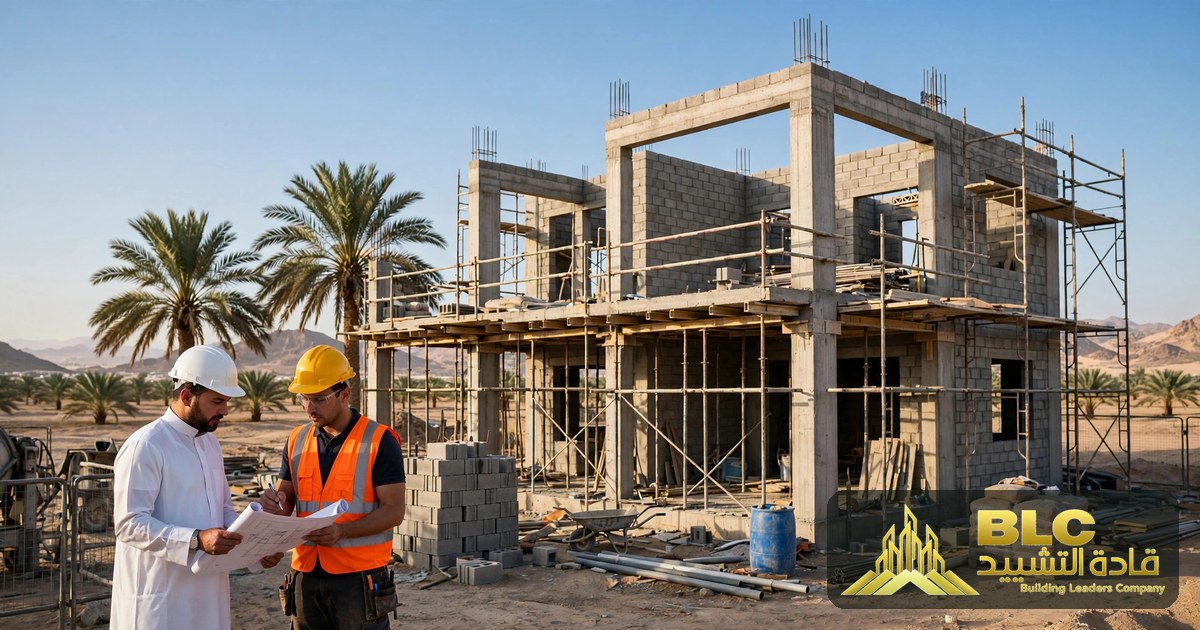
You own a plot in Madinah and you are thinking of building on it yourself instead of buying a ready-made villa. Self-build in Saudi Arabia in 2026 is the choice of thousands of families: build to your taste, pay in stages, save the ready-villa markup. But one step out of order can stall the project for months.
In this guide from Qadat Al-Tashyeed – BLC: what self-build means, how its financing works, the correct order of steps, and the five mistakes that stall a project — with a worked example for a 400 m² villa in Madinah.
What Is Self-Build? And Who Does It Suit?
Self-build means you own the land and manage its construction: the permit in your name, an engineering office for plans and supervision, contractors for execution — and financing, if you need it, released in instalments tied to stages, not in one lump sum.
It differs from buying ready in three ways: you choose the design and finishes; you pay over the build; and the responsibility is yours.
Self-build suits someone who owns land, has time to follow up, and wants a villa to their taste at a lower price than a ready one. It does not suit someone who wants to move in within months or cannot visit the site weekly.
First question: is your land ready? Deed in your name, approved plan, clear setbacks and build-up ratio — any gap stops the permit before you start. See soil investigation before building your villa in Madinah.
Self-Build Financing: How Does Your Money Flow?
Most self-builds are financed through the subsidised housing loan or a bank mortgage. The core idea: the amount is not released in one payment, but in instalments tied to completed stages, each one after an inspection of the previous stage.
The subsidised programme — always confirm the terms with your lender, as programmes are updated — offers a loan of up to SAR 500,000, plus an upfront support package of up to SAR 150,000 depending on terms, income, and eligibility. That package helps at the start, the heaviest stage for cash flow.
Building with your own money is simpler — no lender, no inspections — but the discipline is on you. Keep a written budget and a 10% reserve; without one, the first rise in steel or cement prices stops the project.
The usual deadline for completing a self-build is 36 months from the first instalment — plan to finish before it, because running past it can freeze the remaining instalments.
The Steps of Self-Build, in the Right Order
Order matters more than the steps themselves — a step taken early means rework and paying twice:
- Confirm the land's papers: deed, approved plan, build-up ratio and setbacks — before spending a riyal on design.
- Test the soil: the borehole report sets the foundation type and depth — a wrong foundation is the costliest mistake of all.
- Design the plans: architectural, structural, electrical, and plumbing, with a licensed office — including anything you may need later (lift, annex, third floor).
- Get the building permit: through the Balady platform — see our guide to the building permit for your villa in Madinah before applying.
- Secure latent defects insurance: mandatory for homes — without a valid policy, your procedures stop.
- Contract the shell contractor: a written contract for price, payments, duration, and penalties — never pay more upfront than it states.
- Build in stages and receive each stage: foundations, columns and slabs, walls, finishing — receive each stage before paying for it.
- Obtain the occupancy certificate: after completion and inspection — without it, no official electricity or water supply.
Design comes before the permit, and the permit before digging. Any contractor who says "dig now, permit later" should be dropped at once. In our general contracting projects we never excavate before the permit and the insurance policy are complete.
The Payment Schedule: What Is Released at Each Stage?
Instalments follow real progress. The common sequence — percentages differ by lender, so follow your lender's schedule:
- First instalment: when the land is received and the permit issued — to start excavation.
- Foundations instalment: after the footings and ground beams are done and inspected — any error here shows up years later.
- Structure instalment: after the columns and slabs are done — usually the largest, as the structure is the biggest shell cost.
- First finishing instalment: after blockwork, plastering, and rough-in plumbing and electrics are done.
- Final instalment: after finishing and the occupancy certificate — usually the smallest, tied to handover.
The golden rule: never pay an instalment before inspecting and receiving the stage — it is paid for completion, not for a promise.
Five Mistakes That Stall Your Project and Eat Your Money
Most stalled self-builds do not stall for lack of money — they stall because of five mistakes that repeat every time:
- Starting before the plans are complete: changing the design after casting means demolition — fix everything on paper first.
- Choosing the cheapest contractor with no contract: the cheapest quote without a contract is the most expensive in the end.
- Skipping supervision: errors found only after finishing — supervision costs a fraction of demolition.
- Buying all materials at once: storing steel and cement for months means damage and waste — buy in stages.
- Ignoring the insurance policy and occupancy certificate: without them you cannot proceed or live there lawfully — arrange both from the start.
Latent defects insurance is mandatory for residential buildings — make sure the policy is valid before casting the foundations, because taking it out late is harder and more expensive.
Self-Build or Turnkey? A Quick Comparison
- Self-build: usually 10–20% cheaper than turnkey, with full control over materials and finishes — but it needs weekly follow-up and a longer duration.
- Turnkey: one agreed price, one party responsible, and a shorter duration — but you pay for the convenience and lose some control over materials.
- The common middle path in Madinah: a shell contract with a contractor plus finishing under your supervision with design and decoration — you save on cost and keep control of the most important stage: the finishing.
Many self-builders find the weekly follow-up heavy. If your time is tight, a supervision contract costs less than unsupervised mistakes.
A Worked Example: A 400 m² Villa in Madinah by Self-Build
Take a realistic example: a 600 m² plot, 400 m² built-up, a two-storey villa in Madinah. Figures are indicative, from published 2026 guides:
- The shell: see our guide to the shell price per square metre in Madinah — multiply by the built-up area.
- Finishing: by level — economy, mid-range, or luxury — and the gap between levels can reach hundreds of thousands of riyals.
- Design, supervision, permits, and insurance: budget around 5–8% of the total — items many people forget, then are surprised by.
- Emergency reserve: 10% of the total — never build without a reserve.
- Approximate total: from around SAR 700,000 at economy level to over SAR 1,000,000 at luxury level — and the biggest difference is made by the finishing, not the shell.
The lesson: the shell is stable; the finishing eats the budget unless you fix its level before digging.
Frequently Asked Questions About Self-Build in Saudi Arabia
How long is the self-build deadline in Saudi Arabia?
36 months from the first instalment is the common deadline — plan to finish before it, and check your lender's terms.
How much housing support is there for self-build in 2026?
Up to SAR 500,000, plus an upfront package of up to SAR 150,000 depending on terms — confirm eligibility at application, as programmes change.
Can I build by myself without a contractor?
You need a classified or approved contractor by regulation — but you are the project manager: you choose the contractor, receive the stages, and pay on completion.
What is the first step in self-build?
Confirm the papers and deed, test the soil, design the plans, then get the permit — and do not dig before the permit and the insurance are complete.
How much does self-build cost for a 400 m² villa in Madinah?
Roughly SAR 700,000 at economy level to over SAR 1,000,000 at luxury — the shell is stable; the finishing moves the bill.
Is self-build cheaper than buying a ready villa?
Usually yes — you save the developer's margin — but only with good follow-up, a written contract, and supervision; otherwise the mistakes eat the saving.
Self-build in 2026 is a real opportunity for anyone with land, time, and patience: your land, your plans, your permit and policy, then a contractor with a written contract and payments tied to completion. The engineering consultancy team at Qadat Al-Tashyeed – BLC accompanies you from soil testing to the occupancy certificate — plans, stage supervision, and receiving before every instalment — so you build your home once, and build it right. Request your free consultation now.