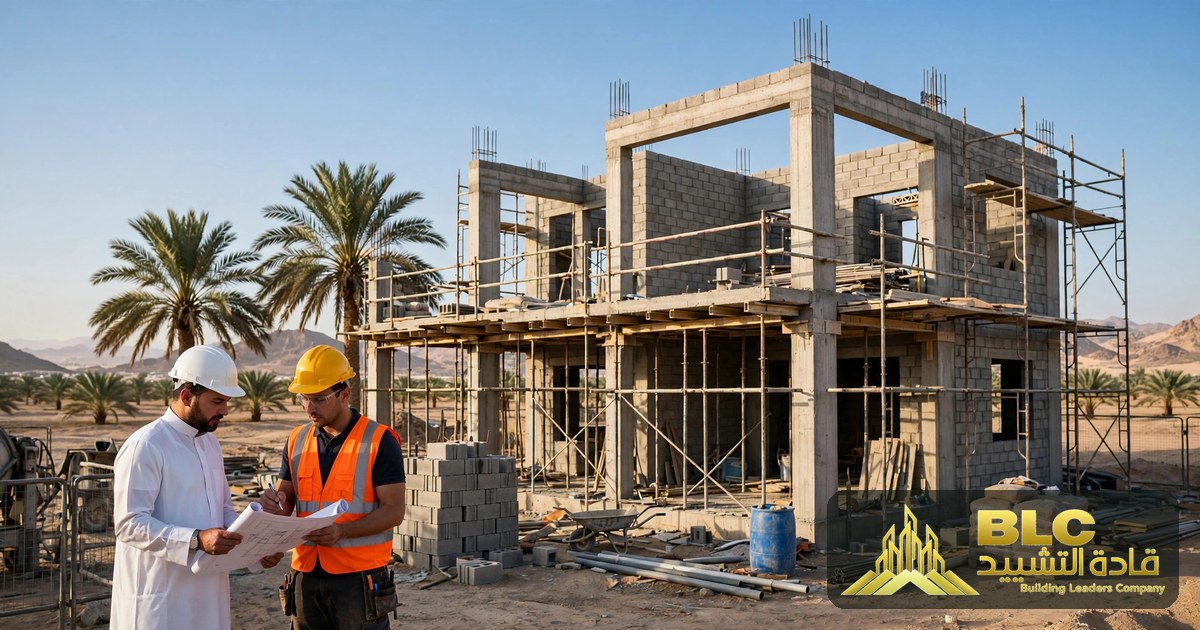
What if your villa could be ready within weeks instead of a full year of building? That is what prefabricated homes in Saudi Arabia 2026 offer: factory-made homes assembled on your land in days or a few weeks. The real question: does it suit you — and what does it really cost?
This guide from Qadat Al-Tashyeed – BLC answers with published 2026 figures: the systems, the real price per meter, the hidden costs, and whether prefab suits Madinah's heat and soil.
What Exactly Is a Prefab Home?
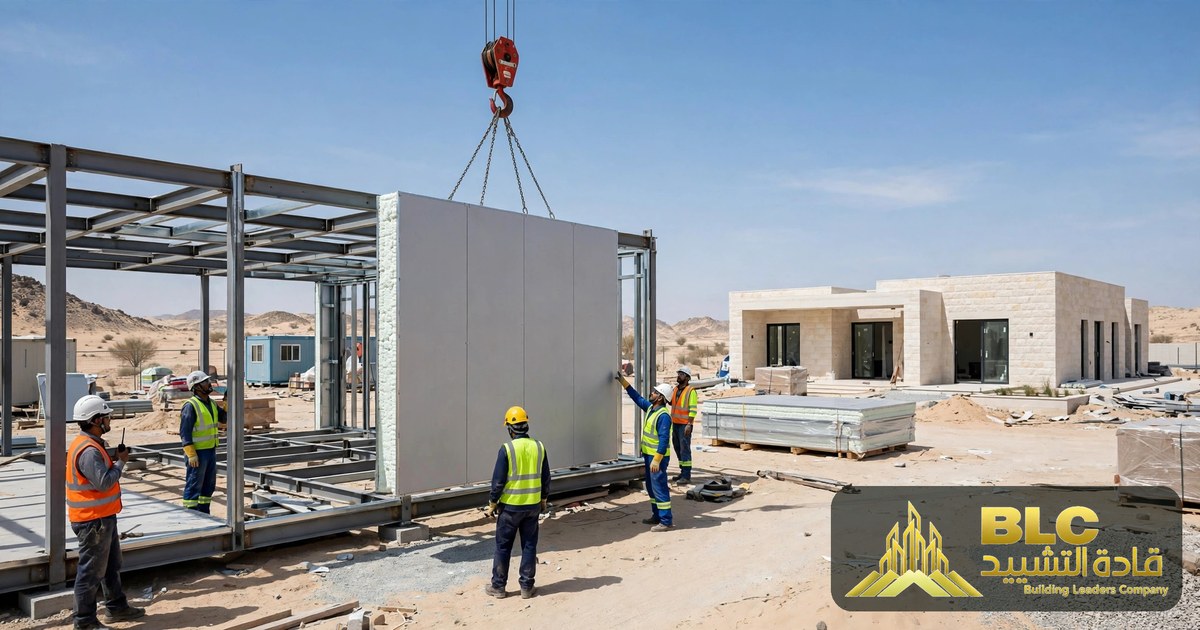
A prefab home is a house whose walls, roofs, and floors are built in a factory under steady quality control, then shipped to your site and assembled on a prepared base — most work happens indoors, not under the site's sun and dust.
One distinction matters: a permanent prefab home is a complete villa built to permanent residential standards, lasting over 50 years — while a temporary unit, like a site cabin, is a lightweight solution for temporary use. This article is about the first.
The Saudi Prefab Market in 2026, in Numbers
Prefab construction in Saudi Arabia is no longer a limited experiment. The Kingdom's modern-methods-of-construction market reached about USD 2.49 billion in 2026, with 44 factories operating, and modern construction methods are used in around 58% of housing projects — an official direction under Vision 2030 and the Modern Construction initiative.
For a Madinah landowner, that means more choices, closer factories, and lower prices — but also suppliers who vary enormously in quality, so your choice of factory and contractor decides your whole experience.
The Three Systems You Can Build With
Most permanent prefab villas in Saudi Arabia use one of three systems:
- Light steel frame: steel structure with insulated wall panels. SAR 900–1,400/m², 45–75 days, good insulation with the right additions, SBC-301 compliant.
- Precast concrete: concrete walls and panels cast in the factory and installed on site. SAR 1,200–1,800/m², 60–90 days, excellent thermal insulation, SBC-304 compliant — the closest in feel to a traditional house.
- SIP panels (sandwich panels): structural insulated panels installed very quickly. SAR 1,100–1,600/m², only 30–50 days, excellent thermal insulation — vital in Madinah's summer.
Container and wooden prefab homes suit rest houses and farms, not a permanent family villa — do not confuse their low price with a permanent villa's price.
How Much Does a Prefab Home Cost in Saudi Arabia?
The advertised price is usually the unit price only, not the total cost. These are the Saudi market averages for 2026, excluding land and permit fees:
- Shipping-container home (20–30 m²): SAR 25,000–55,000; 5–14 days to install; 15–25-year lifespan.
- Steel-frame cabin (40–80 m²): SAR 60,000–140,000; 1–3 weeks to install; 25–35-year lifespan.
- Prefab wooden house (60–120 m²): SAR 90,000–200,000; 2–4 weeks to install; 30–50-year lifespan.
- Permanent modular unit (100–200 m²): SAR 180,000–420,000; 3–6 weeks to install; 50+ year lifespan.
- Precast concrete panels (150–300 m²): SAR 350,000–800,000; 4–8 weeks to install; 50–70-year lifespan.
Prefab costs SAR 800–1,800 per square meter, versus roughly SAR 1,500–2,500 for traditional economy housing — the saving comes from faster execution, less waste, and factory discipline, not cheaper materials.
For the full comparison with traditional costs, see our guide on villa building costs in Madinah.
The Hidden Costs Nobody Budgets For
This is where a "cheap deal" turns into a surprise bill. The advertised unit price usually excludes:
- Concrete foundation: SAR 8,000–30,000, depending on soil and area.
- Transport from factory to site: SAR 2,000–12,000.
- Electricity, water, and sewage connections: SAR 10,000–40,000.
- Air conditioning for Madinah's climate: SAR 5,000–20,000.
- Permit fees and engineering consultant fees: SAR 3,000–10,000.
Always ask for an all-inclusive quotation listing foundation, transport, connections, installation, and finishing item by item — a quote mentioning only the unit price is incomplete, however tempting it looks.
Prefab or Traditional? A Quick Comparison
No option is universally "better" — only the one that fits your situation:
- Duration: prefab takes one to six weeks on site (plus factory time); traditional, 12 to 24 months.
- Cost per meter: prefab SAR 800–1,800 versus SAR 1,500–2,500 for traditional economy housing.
- Thermal insulation: prefab is naturally high thanks to insulated panels; traditional depends entirely on on-site insulation work.
- Flexibility for later changes: traditional is easier for extensions and alterations; prefab needs precise planning, because changes after installation are expensive.
- Bank finance and resale: traditional is clearer to banks and buyers so far; prefab needs stronger documentation to prove its value.
If your priorities are speed, a controlled budget, and a final design clear from the start, prefab is a strong choice. If you expect many changes or a future extension, traditional construction — through general contracting — may suit you better.
Does a Prefab Home Suit Madinah?
Madinah tests any house harshly: summers above 45°C, dust, and soil that varies from one district to another. A prefab home succeeds here on two non-negotiable conditions: real thermal insulation, not cosmetic insulation, and a foundation designed on an actual soil report.
SIP panels and precast concrete lead on thermal insulation, but get written confirmation of insulation thickness and thermal conductivity before you sign — never accept the word "insulated" on its own. Light steel frame needs carefully designed insulation additions to survive Madinah's summer, as decided by the engineering consultant in your design.
A permanent prefab home follows the same permit path through Balady and the same Building Code requirements — only the structural system's documents differ.
5 Mistakes That Cost You Dear Before You Sign
- Contracting on the unit price only: calculate the total cost including foundation, transport, connections, and finishing — the difference can reach tens of thousands.
- Ignoring the soil report: a wrong foundation on untested soil cancels every speed advantage, and fixing it after installation is almost impossible.
- Accepting verbal insulation specifications: ask for insulation thickness, type, and conductivity in the contract — Madinah's heat shows no mercy.
- Designing before confirming the permit: confirm the chosen system is accepted in your permit and district requirements before paying any deposit.
- A contractor with no written warranty: never sign a prefab contract without a written warranty covering the structure, insulation, and leaks, with a clear duration — a verbal warranty is worth nothing at the first problem.
Steps to Build Your Prefab Home With a Contractor
Prefab execution follows this order — skipping any step costs you later:
- Define your needs and total budget: area, rooms, finishing level, and a ceiling you will not exceed.
- Test the soil and check district requirements: the soil report sets the foundation type; the requirements set the setbacks and building ratio.
- Choose the structural system with a consultant: steel, concrete, or panels — by budget, insulation, and timeline.
- Request all-inclusive quotes from two or three factories: compare them item by item.
- Sign a contract stating specifications, warranty, and timeline: insulation thickness, finishing type, delivery date, delay penalties.
- Follow installation and finishing with staged inspection: accept the foundation before installation, the connections before the walls close, and the finishing through finishing works with a written checklist.
For a broader look at modern construction techniques, see our article on modern building methods in Madinah.
Frequently Asked Questions About Prefab Homes in Saudi Arabia
Does a prefab home last as long as a traditional house?
Yes, if it is a permanent system built to the right specifications — a permanent modular unit and precast concrete last 50 years or more, like a traditional house.
How long does a complete prefab villa take?
On-site installation takes 3 to 8 weeks, plus factory manufacturing time. The total is usually between two and three months — 50% to 70% faster than traditional construction.
Does a prefab home need a building permit?
Yes — like any villa, it needs a building permit through the Balady platform and must meet the Saudi Building Code, with the approved structural system's documents attached.
Do banks finance prefab homes?
Finance is available but stricter: the bank wants clearer documents on the system, warranty, and value. Check with your lender before signing.
Which system is best for Madinah's climate?
SIP panels and precast concrete insulate best; light steel frame works well if its insulation is properly designed. The final call depends on your design and budget.
Prefab homes in Saudi Arabia in 2026 are no longer a temporary solution or a gamble — they are a real housing option backed by a growing market, local factories, and clear specifications. But their real value shows in the details: the right system, written insulation, a tested foundation, an all-inclusive contract, and a written-warranty handover.
Thinking of building your villa — prefab or traditional — in Madinah? The team at Qadat Al-Tashyeed – BLC reviews your land, design, and budget, and suggests the most suitable system with no obligation. Request your free consultation now and let us start from your land, not from a catalog.