Did your water bill suddenly jump with no change in your usage? A damp patch appeared on a wall from nowhere? Or a musty smell in a corner you cannot explain? These are all signs of a hidden leak working quietly inside your villa's walls. Water leak detection in Madinah is now an essential service for villa owners: a leak discovered late does not stop at a high bill — it leads to cracked walls, ruined finishes, and weakened concrete over time. This guide covers the signs you can spot yourself, a ten-minute meter test, modern no-break detection, and Madinah prices.
The Hidden Leak: What Happens Inside Your Walls?
Most villa leaks in Madinah come not from visible pipes, but from joints buried inside walls or under tiles. A leak starts as slow drips saturating plaster and blocks; after a few weeks the signs surface: stains, peeling paint, swollen gypsum. The damage you see on the surface is only the tip of the thread; the leak itself is usually a metre or more away from the stain. So the first rule: never break open the wall at the stain before pinpointing the leak — you may break in the wrong place and pay for demolition for nothing.
Madinah's summer heat stresses the network: expanding and contracting pipes strain the joints, especially old pipes without thermal insulation. High water pressure in some neighbourhoods also wears weak joints faster — which is why many leaks appear after summer, or after a house has stood unused.
7 Signs That Reveal a Leak Before It Costs You Thousands
If you notice any of the following, do not ignore it — every day of delay means more moisture inside the wall.
- A water bill that jumps for no reason: a sudden rise with unchanged usage is the clearest sign.
- Damp patches or yellowing: dark or yellow stains that grow, especially below bathrooms and kitchens.
- Peeling paint or bubbling wallpaper: paint peels and gypsum swells as moisture collects behind them.
- A persistent musty smell: a stale smell in a room or corridor despite good ventilation usually comes from an old leak.
- Running water with all taps closed: water moving inside the wall at night means an active leak.
- Loose tiles or dark grout: tiles that move under your feet, or grout turning dark, point to a leak under the floor.
- The meter turning with everything shut off: confirm it yourself with the test below.
One sign is enough to start checking; two mean detection is now a necessity. Remember that wall cracks can sometimes result from long-standing moisture, so do not treat the crack before checking the pipes behind it.
The 10-Minute Meter Test — Find Out Yourself Before Calling Anyone
Before hiring a technician, confirm in ten minutes that a leak really exists — no tools needed:
- Shut off every water source: taps, washing machine, dishwasher, cisterns, and any water-using appliance.
- Record the meter reading: photograph the meter or write the number down.
- Wait a full hour without using any water: the longer the wait, the more accurate the test.
- Read the meter again: any increase means water is moving despite everything being closed.
- Narrow down the source: close the bathroom or kitchen valve and repeat; if the increase stops, the leak is in that branch.
If the meter moves while you are sure everything is closed, that is conclusive: there is a leak, and the next step is a technician with detection equipment — not a plumber who starts breaking walls. Keep photos of the readings; you may need them to dispute a bill.
What Does a Technician Use to Locate a Leak Without Breaking Walls?
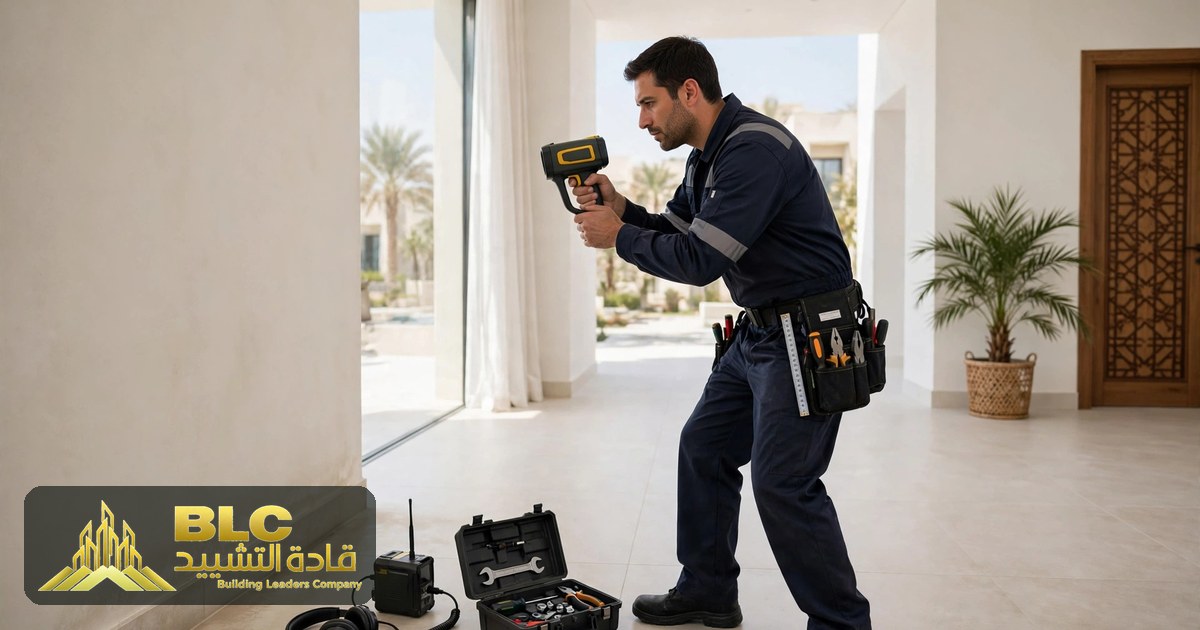
Modern detection no longer relies on guesswork. A professional combines more than one device to pinpoint the leak first:
- Thermal camera: it images temperature differences inside the wall, so the leak shows in a different colour.
- Acoustic listening device: sensitive headphones pick up leaking water inside the pipes, and the technician locates the loudest spot.
- Pressure test: the technician pressurises the network and watches for a drop; how fast it falls shows the leak's size, and the section losing pressure identifies the damaged branch.
- Tracer gas: a safe gas is injected into the pipes, and a detector finds where it escapes — ideal for very small leaks.
Expect more than "there is a leak": a report with the location, the likely cause, the repair method, and an estimated cost — provided in writing by a professional general contracting company before any repair begins. If the leak dates back to the rough-in stage, read our guide on plumbing and electrical rough-in.
How Much Do Detection and Repair Cost in Madinah?
Prices below are indicative for the Madinah market, and vary with the villa's size, bathroom count, and how hard the leak is to reach:
- Detection visit with equipment: usually SAR 100–500, up to SAR 1,200 in complex cases.
- Simple repair: replacing a joint or welding an exposed pipe may cost a few hundred riyals, materials included.
- Buried leak repair: includes limited demolition and re-finishing, starting around SAR 1,000.
- Replacing a network section: if the pipes are old and corroded, replacing the damaged section can be cheaper in the long run than repeated repairs.
Ask for a written quotation before the repair covering detection, repair, and re-finishing, so no "repainting" or "extra demolition" item surprises you afterwards. Early detection always costs far less than restoring a wall saturated for months — not to mention the inflated bills over all that time.
When Do You Need a Certified Report for the Water Company?
If your bill has risen sharply because of a leak, you can dispute it with the National Water Company and request a recalculation. This is where a certified report becomes essential: a documented report proving the leak, its location, and when it was found and repaired. Keep every bill, meter photo, and detection report — a dispute without documents is usually rejected.
It also helps if the leak resulted from a previous contractor's faulty work, or if you discover a leak in a new villa during the warranty period. In these cases the report is your main document for any claim — so choose a provider that issues a written, stamped report, not a verbal opinion.
5 Common Mistakes That Make a Leak Worse
Many villa owners act with good intentions and make it worse:
- Painting over the stain: paint hides the mark but does not stop the leak; moisture keeps working behind it and damages deeper layers.
- Breaking walls before locating the leak: demolishing a whole wall to search for a leak costs a fortune, while detection equipment pinpoints a precise spot.
- Ignoring a small leak: a small leak today can mean a saturated wall after three months, and a bill quietly doubling.
- Using cheap materials: a low-quality joint or weak weld brings the leak back to the same spot within months.
- Skipping insulation after the repair: if the leak is in a wet area such as a bathroom, redoing the waterproofing is part of the solution, not an extra.
Prevention is far cheaper than cure. An annual preventive maintenance schedule includes a regular check of exposed pipes and the meter, and catches leaks at their very start.
Frequently Asked Questions About Water Leak Detection in Madinah
How long does leak detection take in a villa?
One to three hours for a standard two-storey villa. Complex cases may take a full day.
Is no-break detection really accurate?
Yes — combining two or more devices, such as a thermal camera and an acoustic listener, locates the leak within a small area, so demolition is limited to one small opening. One device or guesswork is far less accurate.
Can a leak affect my villa's foundations?
Not over a short period — but a leak running for months saturates the soil around the footings and weakens its bearing capacity, especially in clay soil. Repair floor and footing leaks as soon as they are found.
What is the difference between cold-water and hot-water leaks in detection?
A hot-water leak is easier to find with a thermal camera, and you may even feel warmth in the floor above it. A cold-water leak is harder to distinguish thermally in summer, so the technician relies more on acoustic listening and pressure testing.
Can I rely on a cheap home detection device?
They help with an initial confirmation — a simple moisture meter, for example — but they do not pinpoint a leak inside a wall. Use them as a first step, then call a professional before any demolition.
Spotted one of the seven signs in your home? Do not wait for the stain to grow or the bill to double. Qadat Al-Tashyeed - BLC offers water leak detection in Madinah with modern no-break equipment, a written report, and a clear quotation before any repair. Request your free consultation today, and stop the small leak before it becomes a major restoration.