Five years ago, building a villa in Madinah meant a clean architectural plan and quality finishes. Today, the first question buyers and tenants ask is about the smart home — before the marble, before the facade. And this isn't a passing trend: Saudi Arabia's smart home market is expanding fast, with IMARC data putting it at $94.9 million in 2025 and projecting $370 million by 2034.
The good news: making your villa smart is neither complicated nor wildly expensive — on one condition: the decision has to come at the right time. This guide gives you the full picture: the systems worth your money, indicative prices in the Saudi market, and the mistakes that cost you dearly. And if you're building from scratch, Qadat Al-Tashyeed - BLC wires your smart systems in from the structural phase.
What does a "smart home" actually mean?
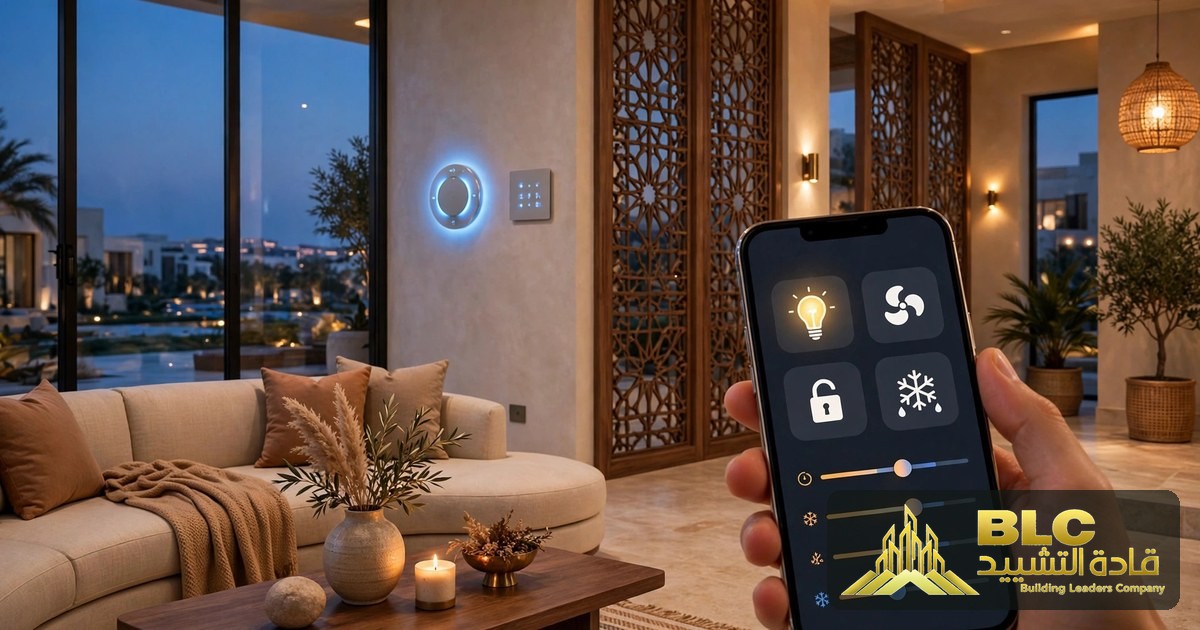
Simply put: a smart home is a villa whose systems you control from your phone or by voice — lighting, air conditioning, cameras, curtains, the gate, even garden irrigation. The point isn't that everything runs on its own; it's that everything runs for you.
A practical example: you're returning from a trip, you open the app fifteen minutes before arriving — the AC switches on to a comfortable temperature, the outdoor lights come on, and the gate opens for you without stepping out of the car. That's not excess luxury; it's daily comfort you feel every single day.
The most important decision: rough-in during the structural phase
The biggest mistake we see in the market: a villa owner finishes the fit-out, moves in, then decides "I want a smart system." The result? Walls broken open, exposed wiring, and doubled costs — or a wireless system that half works and half drops out.
Proper rough-in happens during the structural phase: extra electrical runs to control points, spare conduits inside walls, a network point in every room, and an electrical panel designed to host control modules. The cost difference during the structural phase is small; after finishing, it's large.
This is where an experienced contractor makes the difference: one who plans smart systems from the first drawing, not one who says "we'll add it later." That's why we always recommend starting with an engineering consultation that defines what you want to control before the first brick.
Systems worth your money in a Madinah villa
- Smart lighting: ready-made scenes ("guests", "sleep", "away") and real savings on the bill — lights never get left on again.
- Smart AC control: in a hot city like Madinah, remote temperature control and scheduling cut AC consumption — the biggest item on your electricity bill. Pair it with solar panels and the savings multiply.
- Security and cameras: high-quality cameras, video intercom, and motion sensors — essential for villas whose owners travel often.
- Smart curtains: open and close on schedule or by voice — ideal for bedrooms and glass lounges facing the Madinah sun.
- Gate and garage: open by phone or fingerprint, with an entry log you can review anytime.
- Smart garden irrigation: waters by soil moisture, not by timer — saves water and keeps plants alive in Madinah's heat.
How much do smart systems cost? (Indicative Saudi market figures)
Prices vary by villa size and brand, but to give you a clear picture:
- Basic package (lighting + AC + cameras): SAR 15,000–25,000.
- Mid package (adds curtains, gate, audio): SAR 40,000–80,000.
- Fully integrated system: SAR 100,000 and up.
Field advice: don't start with the full package if your budget is tight — start with complete rough-in during the structural phase (wiring and conduits), then add devices in stages. Rough-in is what can't be redone; devices can be added anytime. Our supplies service helps you pick the right devices for your budget, stage by stage.
5 mistakes that kill your smart home project
- Devices from different brands that don't talk to each other: pick one integrated system or a unified protocol (like KNX or Zigbee) from day one.
- Neglecting the Wi-Fi network: a smart home lives on the network — an access point on every floor, not one router in the majlis.
- Installing after finishing: worth repeating — late rough-in is more expensive and weaker.
- Forgetting maintenance and support: ask about warranty and local technical support before buying, not after.
- Over-complication: a system your family can't use is money thrown away. Simplicity first.
Where do you start?
The first step is always the same: a clear plan before the first brick. Decide what you want to control, and have your contractor rough it in from the structural phase — a natural part of the modern building methods that are now standard for new villas in Madinah. And the earlier the systems enter the design and decor, the cleaner the result looks.
Already living in your villa? Don't despair — there are solid wireless solutions for renovations, though expect higher cost and less flexibility than building-phase rough-in. Even today's home elevator comes with smart controls that integrate with the rest of the house.
Through general contracting at Qadat Al-Tashyeed - BLC, we build villas from structure to finish with complete smart-system rough-in — design, wiring, and installation — so you receive a smart villa from day one.
Ready to make your villa smart?
Book your free consultation with the Qadat Al-Tashyeed - BLC team: we'll study your plan and propose the right systems and budget — whether you're building from scratch or upgrading your current villa. Contact us now and let's plan it right from the start.