If your villa has two or three floors, you know the scene: an elderly parent struggling with the stairs, heavy groceries carried up and down daily, or simply yourself wishing for a button after a long day. A home elevator is no longer a luxury — it raises your villa's value and your family's comfort, especially across Madinah's new districts.
But a wrong choice is expensive. Here's what you need to know before deciding — from the engineers at Qadat Al-Tashyeed - BLC.
When Do You Really Need a Home Elevator?
Four clear cases. Elderly or special-needs family members — here an elevator is a necessity, not an option. A villa of three floors or more, where daily stairs are exhausting and unsafe. Future sale or rental — an elevator raises market value and buyers now ask about it directly. And a villa under construction, where installing during the build is far cheaper than retrofitting later.
Home Elevator Types in the Saudi Market 2026
- Machine-room-less electric: the most common for new villas. Quiet, energy-efficient, no overhead machine room. From around SAR 55,000.
- Hydraulic: oil-pressure driven, extremely smooth, heavier loads. Suits luxury villas. Usually SAR 65,000–120,000.
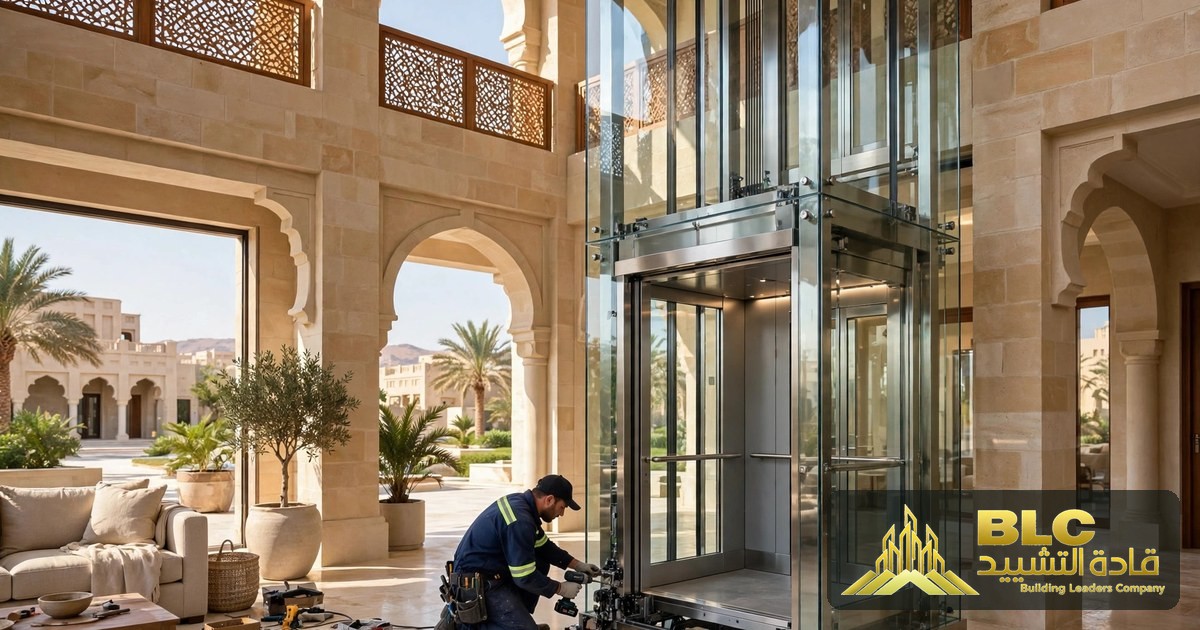
- Screw-driven (panoramic): a glass shaft with no large concrete pit needed — ideal for existing villas. From around SAR 80,000.
- "No-pit" models: compact solutions for existing villas from around SAR 45,000. Note: "no pit" still needs a raised base, electrical work, and doorway adjustments.
The right type depends on your space, stops, and budget — which is why a specialist elevator service that surveys your site first makes all the difference.
How Much Does a Home Elevator Cost in 2026?
Indicative Saudi market ranges for 2026: small 2-stop elevator SAR 40,000–60,000; mid-range hydraulic SAR 65,000–120,000; panoramic glass SAR 80,000–150,000; outdoor with full structure SAR 70,000–200,000.
The final price hinges on five factors: stops, load, door type, finishes, and civil works (pit, structure, electrical). Golden rule: demand an itemized quote separating the elevator from civil and electrical works — a single "all-inclusive" number hides the details.
5 Mistakes You'll Regret After Installation
- Buying on the cheapest price: the difference shows after a year — in maintenance, spare parts, and safety. An elevator lives with you 15–20 years; calculate total cost, not purchase price.
- Skipping the structural survey: loads, shaft path, and top-floor height determine the right type. An engineering consultation before buying saves costly rework.
- Forgetting backup power: insist on an emergency descent system or backup battery — ask about it explicitly before signing.
- Ignoring maintenance and spare parts: who services it after a year? Are parts available locally? A seller who disappears is worse than an expensive one.
- Choosing a non-specialist installer: shaft alignment and door calibration need specialists. Read our guide to choosing a reliable contractor in Madinah first.
Can Your Existing Villa Take an Elevator?
Usually yes, with two conditions: a structural check of foundations and columns near the proposed shaft, and suitable space for the shaft. Screw-driven and outdoor elevators mount on an independent steel structure that barely loads the building — our general contracting team has fitted them into existing villas without touching the original structure, after a proper engineering study first.
Maintenance & Safety
Home elevators are very safe — with annual maintenance: cable or hydraulic checks, emergency brake tests, door-track cleaning. Sign a yearly contract from day one. Strange noise, vibration, or slow doors? Stop the elevator and call the technician immediately.
Ready? Start With a Free Consultation
The wrong type or contractor costs double. The Qadat Al-Tashyeed - BLC team visits your site in Madinah, studies your villa, and recommends the best type and budget — consultation and site visit are free. Contact us now and let's plan it the right way.