If you follow real estate news these days, you have noticed the momentum: Saudi Arabia's Ministry of Commerce reported 19% annual growth in commercial registrations for modern-method real estate development by the end of Q3 2026, reaching 43,900 active records — with Madinah ranking fourth nationwide at over 2,000 records. This is no coincidence; it reflects a clear Vision 2030 push to localize advanced building technologies: faster delivery, higher quality, and lower operating costs.
But the question that matters to you as an owner or investor is: what does modern construction mean for your project? And when is it the right choice? Let me break it down plainly.
What Exactly Do We Mean by "Modern Construction"?
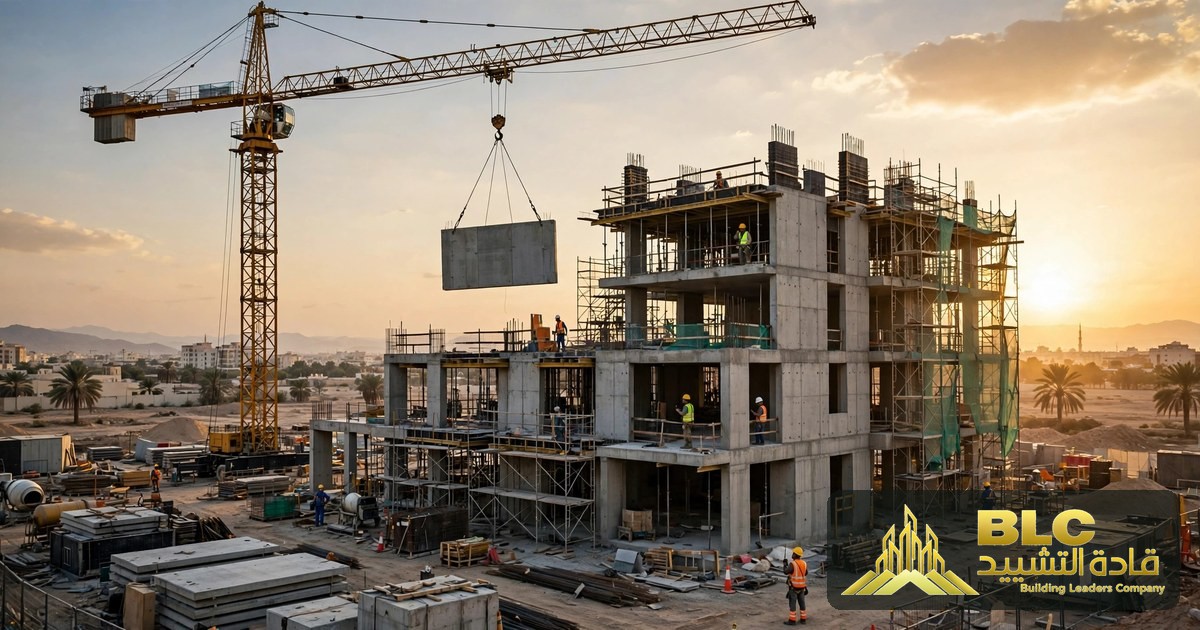
First, an important correction: modern construction does not mean a "modern-looking" building. It refers to the execution method itself: large parts of the building are manufactured in a factory under strict quality control, then transported to the site and assembled — instead of everything being cast and built on-site under the sun and dust.
The most widely used methods today:
- Precast concrete: columns, walls, and slabs cast in a factory to precise specifications, then installed on-site in days instead of weeks.
- Modular systems: complete units — rooms or apartments — finished in the factory and delivered nearly ready. Ideal for repetitive housing projects.
- Insulated concrete forms (ICF): insulating molds assembled as walls and filled with concrete, giving you a concrete wall plus thermal insulation in one step.
- Pre-engineered steel structures: for warehouses and commercial buildings that need wide spans without many columns.
Why Do These Technologies Suit Madinah in Particular?
Madinah has its own conditions, and modern construction addresses several sensitive points:
- Shorter timelines: the factory works in parallel with site preparation, cutting execution time by 30% to 50% compared with traditional methods — a big deal for rental and investment projects.
- Heat resilience: built-in insulation systems reduce air-conditioning loads, meaning lower electricity bills over the building's lifetime.
- Consistent quality: manufacturing in a controlled environment means far fewer errors than on-site casting under the summer sun — every piece meets the same specification.
- Cleaner, quieter sites: less material waste and less noise, which matters a lot when your project sits inside a residential neighborhood.
Add to that the city's major momentum: mega-projects like Knowledge Economic City — targeting thousands of housing units and hotel rooms — are all pushing the market toward faster, more efficient execution methods.
Before You Sign: Five Practical Steps
Modern construction is excellent, but like any technology, it rewards those who plan well. Here are the five most important steps:
- Test the soil and site first: a soil report determines the right foundation type, and some techniques have specific load requirements — never skip this step.
- Choose a genuinely specialized contractor: ask for projects executed with the same technique and go see them yourself. General contracting companies with real modern-construction experience are very different from those "experimenting" on your project.
- Clear permits and municipal requirements: some structural systems need their details approved by the authorities — confirm this before manufacturing, not after.
- Put everything in the contract: technical specifications, a phase-by-phase timeline, and payments tied to actual completion percentages — verbal promises do not work on projects of this scale.
- Monitor quality with engineering supervision: on-site assembly is the most critical phase and needs specialized engineering supervision to verify that every joint and every piece was installed per the drawings.
Common Mistakes That Cost You Dearly
From real project experience, these are the mistakes we see repeated most:
- Hiring a contractor with only traditional experience: modern techniques have precise details in joints and insulation — mistakes are expensive and hard to fix.
- Changing the design after manufacturing starts: factory changes cost multiples of paper changes — finalize your decisions before you begin.
- Neglecting insulation: some owners focus on the structure and forget that thermal and waterproofing insulation determines your comfort and bills for years.
- Judging cost by price-per-meter alone: compare total cost: construction + operation + maintenance over twenty years. For a detailed breakdown of Madinah building figures, see our guide on villa building costs in Madinah 2026.
Where Does قادة التشييد - BLC Fit In?
At قادة التشييد - BLC, we believe today's successful contractor combines field experience with an understanding of modern technologies. We work as a general contractor: from feasibility study and design, to selecting the most suitable execution method for your project and budget, to execution, supervision, and handover — every phase with written specifications and a clear timeline.
Planning to build your home or investment project with the latest methods? Request your free consultation now, and let our engineering team study your project and recommend the most economical and fastest path — with zero obligation.