In Madinah, there is no "good insulation" in the abstract — there is insulation that suits Madinah's heat, and insulation that does not. A villa roof here takes direct sun most days of the year and summer temperatures pass 50°C. Choosing the insulation types that suit Madinah's heat decides whether your home stays cool in summer and dry in winter — or whether you pay a high air-conditioning bill.
In this guide from Qadat Al-Tashyeed - BLC, we compare the main thermal and waterproof insulation types and tell you which fits each situation: a new villa, an existing villa, a used roof, or sun-exposed walls.
Why Madinah's Heat Demands a Different Type of Insulation
Madinah is one of the hottest cities in Saudi Arabia, and its roofs face direct sun for long hours every day. Concrete absorbs heat by day and releases it into the house at night, so weak or wrong insulation turns the roof into a heater.
One type differs from another in a real way: some insulate heat well but absorb water, some resist water but weaken under extreme heat, and some need a protective layer or the sun damages them within one season. The right type combines strong thermal insulation, water resistance, and stability under Madinah's sun — not the cheapest one.
1. Sprayed Polyurethane Foam (SPF): The Strongest Thermally
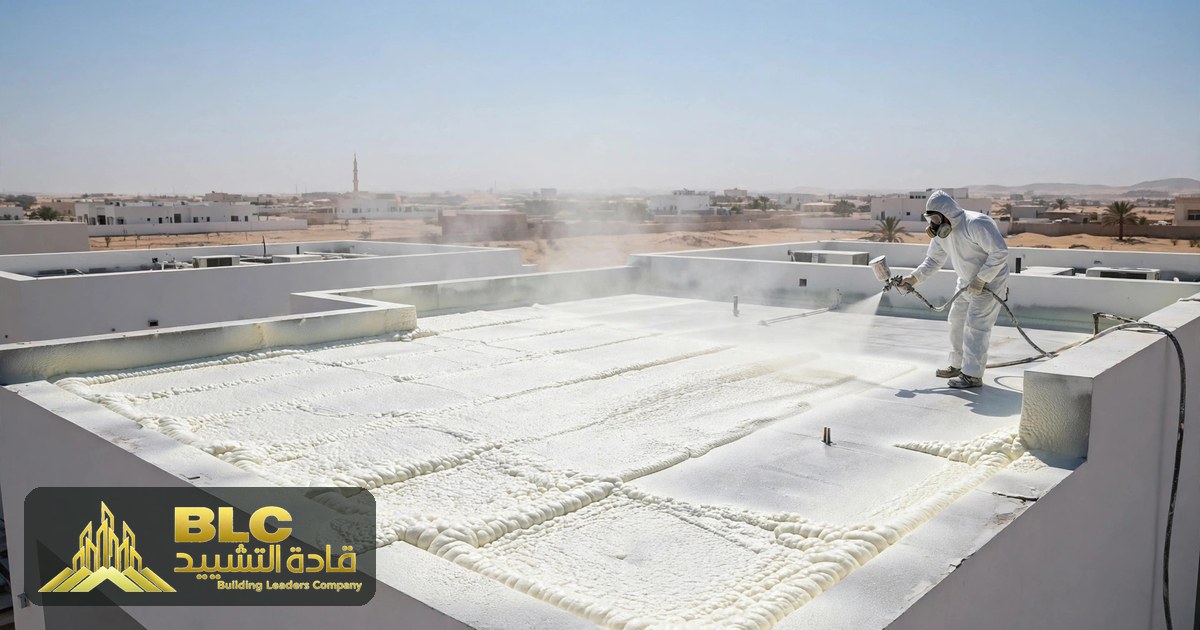
Spray foam is the most widely used insulation on Madinah villa roofs: sprayed as a liquid, it expands and fills every gap and joint around pipes and openings, forming one continuous layer with no seams — the weakest point in any insulation system.
Common Saudi market specifications are a density of 40–45 kg/m³ and a thickness of 3–5 cm for residential roofs, with a protective top coat (acrylic paint or cement screed). Foam without a protective layer peels and cracks from UV radiation within a single summer — the real warranty starts with the protective layer, not the foam itself.
It suits existing and new villa roofs best, especially irregular roofs with many openings — but it needs a professional team and equipment, and any mistake in mixing ratio or thickness shows up after the first summer. Choose a contractor who gives you a written warranty.
2. Polystyrene Boards (XPS and EPS): The Organised Economical Choice
Extruded polystyrene (XPS) and expanded polystyrene (EPS) boards are a common choice in new construction, laid in regular layers of calculated thickness. XPS is stronger and absorbs less water than EPS, so it is preferred for exposed roofs, while EPS suits walls and under-tile applications.
Boards give uniform thickness and predictable results at a lower price than spray foam. Their weakness is the joints: every joint is a potential thermal leak if not treated. Boards with untreated joints insulate 80% of the roof and leave 20% as thermal bridges — and the difference shows up in your air-conditioning bill.
They suit new villas under construction, flat roofs, and exterior walls before finishing. If you are building from scratch, ask your general contracting contractor about adding insulation during the shell stage — it costs far less then.
3. Rock Wool: Thermal and Acoustic Insulation with Fire Resistance
Rock wool is made by melting volcanic rock. It combines good thermal insulation, excellent acoustic insulation, and high fire resistance — it does not burn or melt even at very high temperatures — so it is widely used in exterior walls and suspended ceilings.
Its weakness in Madinah's climate is that it absorbs water if exposed to it directly, and loses much of its thermal efficiency when wet. It is never used alone on exposed roofs, but inside walls or under a sealed waterproof layer. Rock wool without waterproof protection on an exposed roof is insulation that the first rain will ruin — whatever its quality.
It suits double exterior walls, suspended ceilings, and machine rooms best. Near a busy street, rock wool in the walls also noticeably reduces noise — a benefit foam and boards do not offer.
4. Reflective Insulation and Heat-Reflective Coatings
Reflective insulation — aluminium foil layers and heat-reflective paints — works differently: instead of absorbing heat, it reflects much of the solar radiation before it enters the roof. It is very effective in Madinah, where most heat comes from direct sun.
But reflective insulation alone is not enough. It is an excellent supporting layer over a main system (foam or boards), but as a complete replacement it gives modest results on hot nights, because concrete stores heat and releases it indoors. Use it as a protective layer, not a substitute — best as a coat over spray foam and on west and south facades exposed to the afternoon sun.
5. Waterproofing: The Other Half of the Equation
Many villa owners focus on thermal insulation and forget that water is the first enemy of insulation itself and of the roof. In Madinah, the three main waterproofing types are bitumen rolls, liquid membranes, and PVC and TPO membranes.
Bitumen rolls are the most widespread and have proven themselves over decades in Saudi Arabia: applied with heat, they form a continuous waterproof layer at a reasonable price. Liquid membranes are easier around details, corners, and pipes, because they are painted on and fill everything — an excellent choice for old roofs. PVC and TPO membranes are the most expensive and longest-lasting.
The golden rule in Madinah: in most Saudi roof systems, waterproofing goes first on the concrete, then thermal insulation above it, then the protective layer — reversing this order exposes the thermal insulation to water and shortens its life. We explained this order in our guides to foam insulation for villa roofs and roof insulation before the rainy season.
Quick Comparison: What Should You Choose?
- Spray foam: Best for existing and irregular roofs — no joints, but needs a protective layer and a professional installer.
- XPS boards: Best for new construction and flat roofs — economical and uniform, if joints are treated.
- Rock wool: Best for walls and ceilings — thermal, acoustic, and fire-resistant, but never alone on exposed roofs.
- Reflective insulation: Best as a supporting layer — it reflects the sun but does not replace the main insulation.
- Bitumen rolls: Best for proven, economical waterproofing — liquid membranes suit old roofs.
Indicative price ranges for each type are in our guide to the insulation price per square meter in Madinah 2026.
Which Type Suits Your Situation?
- Building a new villa? Add insulation during the shell stage: XPS boards for walls and roofs, plus waterproofing rolls before tiling.
- Villa built and the roof exposed? Spray foam with a reflective protective layer covers the existing roof without demolition. Fix old cracks or leaks first — insulation over an active leak hides the problem.
- A used roof (seating area or laundry)? Choose a system that tolerates foot traffic: XPS boards covered with tiles, or foam with a cement protective layer.
- West walls hit by the afternoon sun? Insulate from outside with boards or rock wool inside a double wall, with reflective paint on the facade — it noticeably cools west-facing rooms.
Planning a full renovation? Coordinate insulation with the rest of the work — see our guide to choosing a renovation contractor in Madinah.
5 Common Mistakes When Choosing an Insulation Type
- Choosing the cheapest without specifications: A quote with no density, thickness, or protective layer is incomplete — compare specifications first.
- Thermal insulation without waterproofing: In Madinah, a single winter rain can damage unprotected thermal insulation — the complete system is cheaper than the repair.
- Ignoring the protective layer: Exposed foam and boards are damaged by the sun; the protective layer costs a fraction of redoing the insulation.
- Insulating the roof and forgetting the walls: West and south walls leak no less heat than the roof.
- Work without a written warranty: A verbal warranty is worthless — ask for one in writing, stating duration, coverage, and who pays for repairs.
How to Make Sure the Type You Chose Is Really Suitable
Before signing, ask for three things: a written specification sheet (type, density, thickness, protective layer, waterproofing type); a free on-site inspection; and a written warranty with clear duration and coverage.
The Bottom Line: No Single Type Suits Everyone
Madinah's heat is severe, but the solution is not one magic type — it is the right system for your roof and budget: foam for existing roofs, boards for new construction, rock wool for walls, reflective layers as support, and solid waterproofing under everything. The right investment in insulation pays you back in your air-conditioning bill and your home's comfort for years — the wrong choice you pay for twice.
The Qadat Al-Tashyeed - BLC team installs thermal and waterproof insulation systems in Madinah — from the free roof inspection to installation with a written warranty. Request your free consultation today, and make your home's insulation a calculated decision instead of a gamble.