Madinah summers reach 50°C, and when the rain comes it comes hard — and your villa's roof is the first line of defence. That is why roof insulation in Madinah with spray foam has become the first choice for villa owners: one solution that stops heat and leaks together, instead of paying twice.
Why foam?
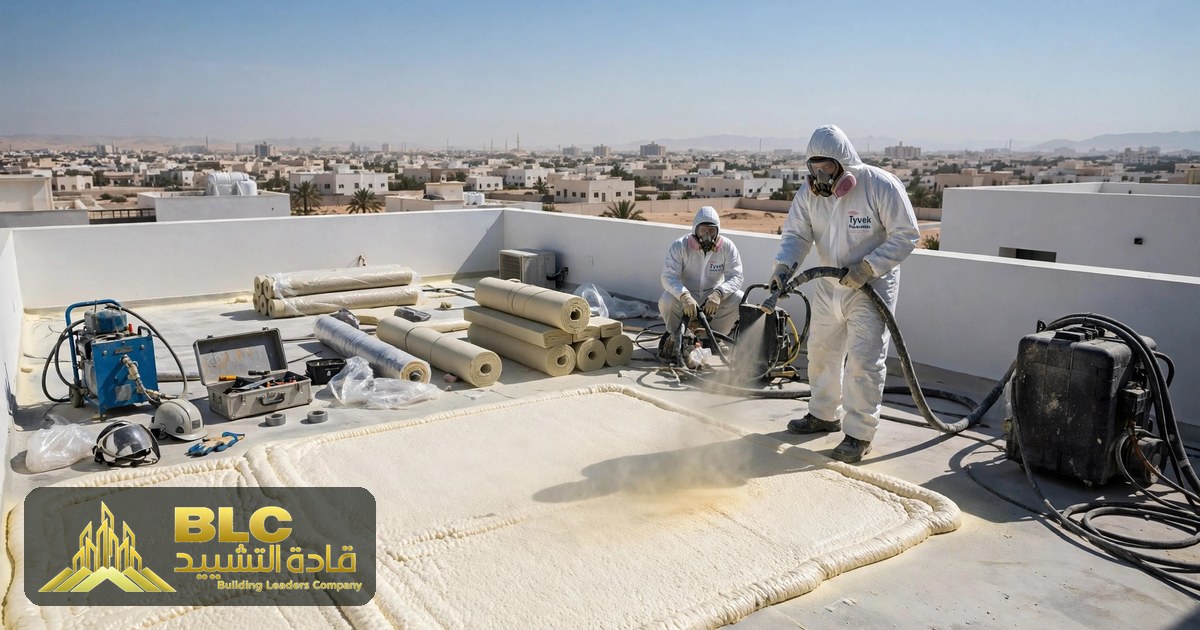
Spray polyurethane foam is sprayed as a liquid and expands into a single continuous layer with no joints or seams — and joints are the weakest point of any insulation, where leaks usually start. It insulates against water and heat in one layer, and bonds directly to the concrete, covering corners, pipe edges and AC openings that rolls cannot reach.
The golden rule: insulation with many joints is the insulation that leaks first — foam removes the joints altogether.
The right foam specs
Not all foam is equal. Ask for these four points in writing in the quote:
- Density 40–45 kg/m³ — lower than that turns brittle and cracks in Madinah's heat.
- Thickness 3–5 cm — thicker means stronger thermal insulation, but extra thickness without a reason only raises the cost.
- Closed cells — so it does not absorb water; open-cell foam soaks up moisture and loses its insulation.
- Protective coat — an acrylic coating or screed after spraying, because foam suffers under direct sun.
Ask about density and thickness before the price — a cheap price with low density is the most expensive insulation in the end.
Price per square meter in Madinah
The price per meter is not fixed; it depends on foam density and thickness, roof area, the roof's condition, and the type of protective coat.
The prevailing market range for sprayed foam to the right specs is roughly SAR 45–80 per square meter, including spraying and the protective coat. The exact price for your roof is set by a free site survey: we measure the area, check slopes and cracks, and give you a written quote before we start.
The warranty
Any contractor can say "our work is guaranteed", but a real warranty is written and certified. At Qadat Al-Tashyeed – BLC we provide a certified ten-year warranty on insulation works, covering leaks caused by faults in workmanship or materials.
Check that any warranty is certified by the Chamber of Commerce, not a verbal promise — and know what it does not cover.
How we apply foam insulation
- Survey: we inspect the roof and slopes and locate water pooling and cracks.
- Preparation: cleaning the roof, repairing cracks and adjusting slopes towards the drains.
- Spraying: foam at the agreed density and thickness, covering corners, edges and pipe collars.
- Protective coat: an acrylic coating or light screed to shield the foam from the sun.
- Flood test: we flood the roof with water and monitor it before handover — any contractor who refuses the flood test should not be trusted with your roof.
The bottom line
Foam insulation is the best fit for Madinah villa roofs — but its real value lies in the specs: density 40–45, thickness 3–5 cm, closed cells, a protective coat, and a flood test before handover. Never sign an insulation quote without written specs and a certified warranty — the paperwork is what protects you after the contractor leaves.
To know the exact price per square meter for your villa's roof, book a free consultation — we will survey the roof and give you a written quote with specs and warranty. Also read our complete guide to roof insulation before the rainy season and our guide to rainwater drainage for villas, and explore our insulation, general contracting and finishing works services.
Surface Preparation and Protection: Where Foam Quality Is Decided
Most foam insulation failures in Madinah are decided before the spraying machine ever starts. Foam bonds to whatever lies beneath it, so dust, moisture, or loose old material becomes a built-in weakness. Proper preparation means thorough cleaning and washing, repairing cracks, falls, and old leaks, then allowing the roof to dry completely, because moisture trapped under a closed layer turns to vapour in summer heat and causes blistering and delamination. Every protruding element, from drainage outlets to air-conditioning bases and pipes, must be masked and protected before spraying begins.
Foam also needs a protective layer above it. Left exposed, it degrades under intense ultraviolet light and cannot withstand regular foot traffic. A flexible acrylic coating is the lightest option for roofs used only occasionally, and it needs periodic renewal. A cementitious screed gives stronger mechanical protection on service roofs visited often by technicians. Tiling over a suitable protection system suits roofs planned as living terraces, but it is the heaviest and costliest choice and demands that structure, insulation, and drainage are confirmed sound first, since later repairs must pass through it.
Owners can verify much of the workmanship themselves: check thickness consistency, especially near parapets and pipes, press for hollow or moving areas that signal poor adhesion, look for bubbles and pinholes, and rely on a ponding test or the first real rain, watched from the ceilings below, as the final practical verdict. Seasonal visual checks and timely renewal of the protective coating keep the whole system working for years.
Frequently Asked Questions
Can foam be sprayed over existing insulation?
Sometimes, if the old layer is dry, sound, and fully bonded. Detached or moisture-saturated insulation must be removed first, or the new foam will inherit its failure.
Is the protective coating always included in a foam quote?
Not necessarily. Confirm in writing whether the price includes a protective layer and which type, or covers spraying only, before you sign.